The History and Lore of the Tennis Bracelet: From Sporting Mishap to Style Icon
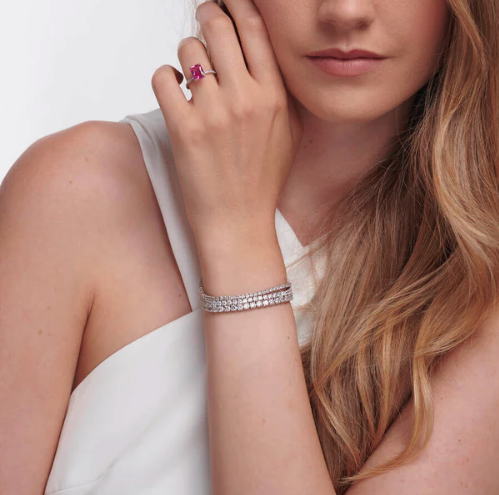
The tennis bracelet occupies a rare position in jewellery history. It is a piece defined not by royal patronage or ancient tradition, but by a modern cultural moment that permanently altered how fine jewellery is worn. Elegant yet understated, the tennis bracelet has evolved from a practical line bracelet into a symbol of effortless luxury, everyday confidence and enduring style.
Today, the tennis bracelet is considered a staple rather than a statement. Its appeal lies in its adaptability. It can be worn with evening wear, office tailoring or casual clothing without ever feeling out of place. Yet its origins are rooted in a very specific moment in sporting history that transformed public perception of jewellery forever.
Before the term tennis bracelet entered the lexicon, the design existed simply as a diamond line bracelet. These bracelets featured a continuous row of individually set stones, typically diamonds, linked together to create flexibility and fluidity on the wrist. They were admired for their symmetry and refinement, but largely reserved for formal occasions.
That perception changed dramatically in 1987 during the US Open.
While competing at the tournament, tennis champion Chris Evert famously stopped play after the diamond bracelet she was wearing broke and fell from her wrist. The moment was widely reported, and the story quickly captured public imagination. Coverage by outlets such as The New York Times documented how Evert’s insistence on retrieving the bracelet brought attention to the idea of fine jewellery being worn during intense athletic competition.
This incident marked a cultural turning point. Jewellery was no longer confined to formal settings or protected environments. It could move, flex and exist in the real world. The diamond line bracelet became known as the tennis bracelet, named not by designers or jewellers, but by popular culture itself.
What made this moment so influential was not simply the celebrity involved, but the message it conveyed. A tennis bracelet was elegant enough for evening wear, yet robust enough to be worn on the court. That duality would come to define its lasting appeal.
Fashion historians writing for Vogue have noted that the tennis bracelet’s rise coincided with a broader shift in how women approached luxury. Jewellery was no longer something to be saved for special occasions. It became part of everyday identity, worn for the wearer rather than an audience.
Throughout the late 1980s and 1990s, the tennis bracelet gained traction as a symbol of understated affluence. Unlike statement necklaces or oversized cocktail rings, it communicated refinement without excess. Its uniform design allowed it to complement rather than dominate an outfit.
This subtlety contributed to its longevity. While jewellery trends rose and fell, the tennis bracelet remained quietly consistent. Its design did not rely on fashion cycles. Instead, it relied on balance, proportion and craftsmanship.
Editorial analysis in Harper’s Bazaar has explored how the tennis bracelet became associated with modern femininity. It was not about display, but about confidence. Wearing diamonds casually signalled self-assurance rather than extravagance.
Over time, the tennis bracelet also evolved technically. Early designs were often delicate, with limited flexibility. As demand grew for everyday wear, construction methods improved. Settings became more secure, clasps more discreet and articulation more fluid.
These technical advancements were crucial. The tennis bracelet’s promise was wearability, and that promise had to be supported by engineering as much as aesthetics. Industry commentary from the Gemological Institute of America has highlighted how advances in setting techniques allowed continuous diamond bracelets to become both elegant and durable.
By the early 2000s, the tennis bracelet had cemented its place as a jewellery essential. It was no longer defined by its origin story alone, but by its adaptability. It could be worn solo for minimal elegance or stacked for a more expressive look.
The rise of casual luxury further amplified its appeal. As dress codes relaxed and personal style became more fluid, jewellery that could transition seamlessly between contexts became highly desirable. The tennis bracelet fit this role perfectly.
Cultural reporting in The Guardian has examined how modern luxury is increasingly defined by versatility rather than formality. Pieces that integrate effortlessly into daily life tend to endure far longer than those tied to specific occasions.
The tennis bracelet also carries symbolic weight beyond its design. Its continuous line of stones has been interpreted as a representation of continuity, balance and lasting connection. This symbolism has made it a popular choice for milestone gifts, anniversaries and personal celebrations.
Unlike engagement rings or pendants, which often carry explicit romantic meaning, the tennis bracelet offers a more open narrative. It can signify achievement, self-purchase or personal growth just as easily as partnership. This flexibility has broadened its appeal across generations.
Editorial features in Elle have highlighted how younger buyers are drawn to jewellery that does not require explanation. The tennis bracelet’s simplicity allows it to adapt to individual meaning rather than imposing one.
The piece has also benefitted from changing attitudes towards layering and styling. Contemporary fashion embraces mixing metals, stacking bracelets and combining fine jewellery with casual pieces. The tennis bracelet acts as a neutral anchor within these combinations.
Design commentary in Dezeen has noted that minimalist forms often provide the strongest foundation for personal expression. The tennis bracelet’s clean lines make it endlessly adaptable, whether worn alone or alongside watches and bangles.
Its relevance has been reinforced by visibility in popular culture. Celebrities continue to wear tennis bracelets both on and off the red carpet, reinforcing the idea that diamonds do not need to be reserved for formal moments.
Coverage in Vanity Fair has observed that modern style icons often favour pieces that feel personal rather than performative. The tennis bracelet aligns with this ethos, offering luxury without overt signalling.
Another factor contributing to its endurance is accessibility across price points and materials. While traditionally associated with diamonds, tennis bracelets now exist in a variety of interpretations, allowing a wider audience to engage with the design without compromising its essence.
Economic analysis in the Financial Times has explored how luxury categories that balance aspiration with accessibility tend to perform consistently over time. The tennis bracelet’s adaptability has allowed it to remain relevant across shifting market conditions.
Despite its evolution, the core appeal of the tennis bracelet remains unchanged. It is a piece defined by balance. It does not seek attention, yet it never goes unnoticed. It enhances rather than overwhelms.
In an era where jewellery trends often swing between extremes, the tennis bracelet offers stability. It is neither overly decorative nor aggressively minimal. Its strength lies in its restraint.
As we look to the future, the tennis bracelet shows no signs of fading. Its story continues to resonate because it reflects modern values. Confidence without ostentation. Luxury without limitation. Beauty designed for real life.
What began as an accidental moment on a tennis court has become one of the most enduring designs in jewellery history. The tennis bracelet is no longer defined by sport alone, but by a philosophy of wearability and self-expression.
It is this blend of history, practicality and quiet elegance that ensures the tennis bracelet remains not just relevant, but essential.
A piece with a story, a purpose and a place in everyday life.